If a shop told you your truck needs "SPS2" or "module programming," this explains what that actually means, when it's required, and what to have ready before you book.
By Kardo Smith, owner of KardoTuned · October 22, 2026
"SPS2" is the name of GM's factory software tool. It is not a performance product, and it is not a tune. It is the program a GM dealer uses to put correct, factory-issued software onto a module so the vehicle works the way General Motors designed it to.
I'm Kardo Smith. I own and run KardoTuned in Lithonia, and a good share of what comes through my bay is GM trucks and cars that need a module programmed rather than a part thrown at them. This article explains what SPS2 does in plain terms, when your truck actually needs it, and what I need from you before I can tell you what it will cost.
SPS2 stands for Service Programming System, generation 2. It is GM's own software for flashing and configuring control modules on GM vehicles — Chevrolet, GMC, Buick, and Cadillac. Dealers use it, and independent shops like mine can use it too, provided they pay for the right access.
Running it takes three things working together:
The practical result: a dealer-level flash can be done outside a dealership. You don't need to take a truck to a Chevy store and wait three days for an appointment.
Programming is not maintenance. You don't do it on a schedule, and you shouldn't do it "just because." These are the situations where it's genuinely required.
1. You replaced a module. A new ECM (engine control module), PCM (powertrain control module), TCM (transmission control module), or BCM (body control module) arrives blank or with generic software. It will not run your vehicle until the correct calibration is flashed onto it and it is configured. A brand-new module still needs programming — "new" does not mean "ready."
2. You bought a used module. A used module carries the identity of the vehicle it came out of — its VIN, its security data, its configuration. Installing it as-is commonly produces a no-start, communication faults, or a security lockout. It has to be set up so it matches your truck's VIN. Sometimes that means a full reflash, sometimes a security relearn, sometimes a "virginize" step first so the module will accept new data at all.
3. GM released a software update or recalibration. Service bulletins occasionally call for updated software to correct a known drivability issue, shifting complaint, or calibration error. When a bulletin calls for a recalibration, SPS2 is how that update gets installed.
4. A repair required reprogramming afterward. Some jobs aren't finished when the wrench work is. Replacing certain components, addressing a module that lost its configuration during a voltage event, or performing a repair that disturbs the network can all require a reprogramming step before the vehicle is truly corrected.
Programming is not the same as tuning
SPS2 installs GM's factory software — the calibration the engineers intended. HP Tuners is a different tool for a different goal: it changes calibration tables (fueling, timing, shift strategy, torque management) to alter how the vehicle performs. One restores or installs factory behavior. The other deliberately departs from it. If your truck has an aftermarket tune, tell me before I program it — a factory flash will overwrite that tune, and that is not a conversation you want to have afterward.
A flash is not an instant event. The module is being written to, byte by byte, over a span of minutes while the vehicle's electrical system is loading and unloading. If battery voltage sags mid-write — a weak battery, a door chime, a cooling fan kicking on, an interior light somebody opened — the write can stop partway through.
When that happens, the module can be left in an incomplete state. It may no longer communicate. It may no longer accept a programming attempt at all. In the worst case, a module that was working before the job becomes scrap.
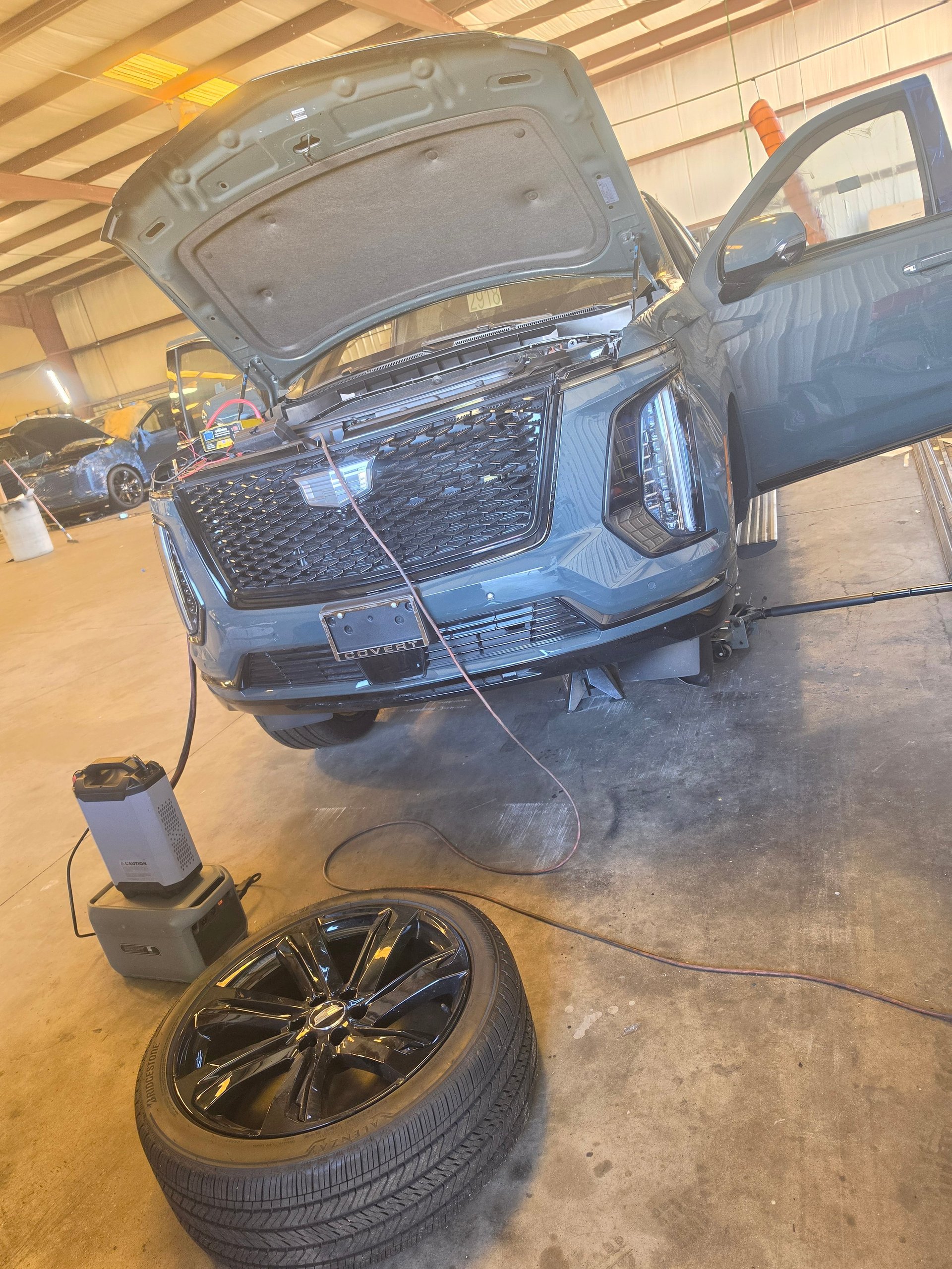
That's why every programming session here runs on a dedicated programming power supply, not a battery charger and not a jump box. Those two things are not the same as a regulated supply that holds voltage steady for the entire write. It's a small amount of setup that protects the module, your time, and the money you already spent on the part.
I confirm compatibility by VIN before I promise anything, because not every module on every model year supports the same process. Some need extra security steps. Some aren't supported through this path at all. Finding that out on the day of service wastes your trip.
Send me these five things and I can give you a real answer:
01
Year
02
Make
03
Model
04
VIN
05
Part #
To be clear on the details:
Programming is quoted per vehicle. What a job costs depends on how many modules are involved, whether it's a new or used module, and how straightforward the process turns out to be once I've checked your VIN.
Complex jobs — multiple modules, security relearns, used modules that need extra preparation, or a vehicle where the process isn't straightforward — are priced by time. I'll tell you what I expect it to take after I've looked at your VIN and the module involved, and you approve that before I start. No surprise invoice at the end.
What I won't do is quote you a flat number for a job I haven't checked. If your module turns out to need a bench procedure or isn't supported, you'll hear that from me before you drive anywhere.
SPS2 is GM's factory programming system. You need it when a module is replaced, when a used module has to be matched to your VIN, when GM issues an update, or when a repair calls for a reprogramming step. It is not a tune, and a tune is not a substitute for it. It depends on stable power, and it depends on the right VIN information before the job begins.
If you're in Metro Atlanta — Lithonia, Stone Mountain, Decatur, Conyers, or anywhere nearby — and your truck needs a module programmed, send me your year, make, model, and VIN. I'll confirm whether I can program it and what it will cost.
About The Author
Kardo owns and runs KardoTuned, an independent diagnostics, programming, and GM tuning shop based in Lithonia, Georgia, serving all of Metro Atlanta. He works with HP Tuners, GM Techline Connect/SPS2 through a J2534 pass-thru, a Topdon Phoenix Max, an oscilloscope, and a dedicated programming power supply. Every job here is handled by the person whose name is on the door.
Send your year, make, model, and VIN. I'll confirm compatibility and give you a straight price before any work begins.